The Jewish community of Almelo
History
The
history of the Jews in Almelo dates back to the 17th century.
The first known Jew,
mentioned in our sources, was Isaac Arents,
living in Almelo in 1660. During the eighteenth century
Jewish names often appear in documents. In 1772 seven
male Jews lived in Almelo, including Abraham Moses,
already mentioned in 1731. Their number increased during
the time. Towards the end of the eighteenth century the
Jewish community of Almelo had become a medium-sized
community, according to Dutch Jewish standards.
The main
growth of the community took place
in the nineteenth century, as a
result of the economic growth and
development of the town and
surroundings.
In the
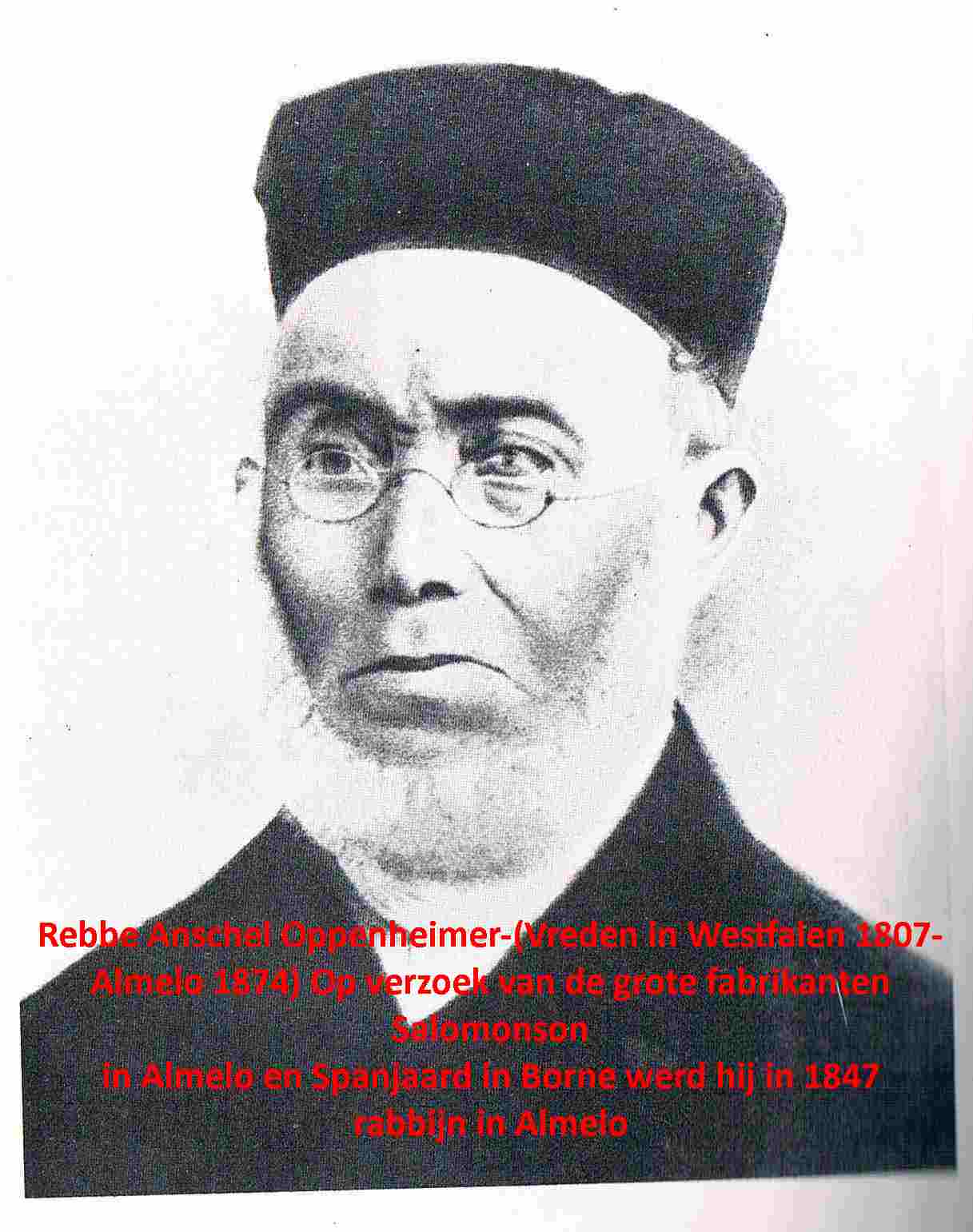
middle of the nineteenth century a study group, named
"Talmud Torah," was established by the rabbi, rabbi
Anschel Oppenheimer, a well known Talmudic scholar
(1807-1874). Rabbi Oppenheimer, also named Anschel of
Almelo, hailed from Vreden in Germany. He traded in
spices and lived in Almelo from 1847 till 1874 where he
was very influential. He was the rabbi, the teacher and
the mohel and during his years in office he persuaded
many Jews to become members of the community.
The church council and societies
The church
council consisted of seven members.
There was a society for the poor and
a treasurer for the Holy Land. The
society for the poor "Gemilus
Chasodiem" was established in 1855.
Other societies in Almelo were the
study group "Mekour Chajiem,"
established in 1888, the women
society "Nosjiem Zadkonious," from
1860, the youth movement "Tiferes
Bachoeriem," from 1852, and another
woman society "Lechovoud Ulesiferes,"
from 1890.
These
societies provide an indication of
the flourishing Jewish life in
Almelo in the middle of the 19th century,
with emphasis on the care for the
poor. At the start of the 20th
century we find in Almelo, besides
the well-to-do, also many poor and
needy people (70 from the 562 in
1901).
In 1916
the Dutch Jewish Community also
established a society with the name
of
"Gemilus Chasodiem". There
were therefore two societies with
the same name and purpose. In our
sources we could not trace any
further information regarding the
previous society, founded in 1855.
The newer society - from 1916 - was
responsible for the care of the ill,
the dying, and the needy. From the
start of the 20th century
immigrants and refugees from Eastern
Europe were absorbed by a special
society, "Hachnosas Ourechim."
Other
societies were dedicated to social
and cultural purposes and from 1930
there was also Zionistic activity.
The Zionist youth movement "Hazoriem" counted seventeen
members at the end of the thirties, and there was a
group of orthodox Palestine pioneers, organized in "Dat
wa-Arets." Members of the Society of
Professional Education of Palestine pioneers,
also called "the Deventer Society," received their
agricultural training in the surroundings of Almelo. The
members of this society maintained contact with the "Chaluziem
movement" of Deventer.
Synagogue
The old
synagogue, known to be situated in the Bodden in the
year 1803 - the year of foundation is unknown - became
too small for the growing community. New premises were
found at the Schalderoi, which were entirely renovated
in 1860. These premises however had to be left, as a
result of a restoration planned by the Almelo
municipality. The building was sold to the municipality
on the condition that the municipality would provide
proper accommodation for the Jewish community. In 1971
the municipality renovated the school building opposite
the old synagogue, for synagogue services and meetings
of the Jewish community. When this building also had to
be demolished, the Reformed church offered
accommodation.
Although
the synagogue survived the war
without a scratch, thanks to the
Almelo municipality, which claimed
the building for potato storage, it
had become too large and also
difficult to heat, so it was not too
hard to leave the building.
The new
synagogue was built in the old style
of the adjoining buildings of the
Kerkplein. The interior of the
Schalderoi synagogue found its place
in the new synagogue. The Aron
Hakodesh was restored and installed.
The Torah rolls, hidden in Amsterdam
during the war, were returned. The
expense of the new synagogue was
born for 2/7 by the Jewish community
and the remainder was paid by the
government.
Since 1999
the synagogue bears the name of Aron
Haas, as a sign of honor to him, in
appreciation of the moving power he
showed during the restoration of the
Jewish community of Almelo after the
war.
Cemetery
The first old cemetery dating from 1775, situated at the Sluitersveld near the Kerkhofweg was closed and a new one was established in 1845 at the Boddenstraat.
Jewish school
Not much
is known about Jewish education in Almelo. During the 19th century
the children received Jewish schooling and in 1926 a new
school building was employed.
Industry
The Jews
played an important part in the textile industry, which
was well known in this part of
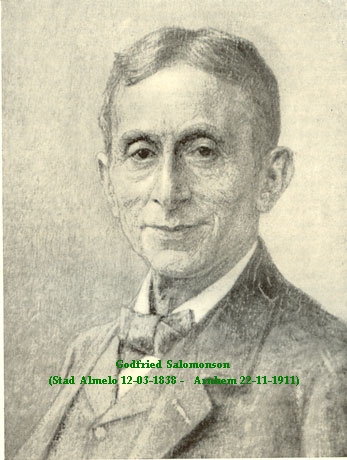
the Netherlands. The most important
industrialists were Mozes, Joseph and Gottfried
Salomonson. In 1796 Mozes Salomon obtained the right to
live in town and in 1812 he changed his family name to
Salomonson.
His sons
founded the firm of G and H
Salomonson and by 1835 they had
acquired a well known reputation in
the export of cotton products. In
1852 they founded the Koninklijke
Stoomweverij in the neighboring
village of Nijverdal, which thanked
its industrial development to this
factory.
The firm
Bendien founded the damask industry in Ootmarsum and
moved afterwards to Almelo. Isaac Bendien started his
career as a peddler and became the founder of the
clothing industry in Almelo.The firm
of Heideman should also be mentioned
as one of the most important textile
manufacturers.
After the war
The
greater part of the Jewish inhabitants of Almelo did not
return from the camps; from the 265 deported only six
returned. 160 Jews were hidden during the war and
survived.
After the
war the Jewish community of Almelo was reinstated and it
remained active for a long time. From 1945 till 1970
L.F. Israels was the teacher of the community. He
schooled a number of young people to take their place in
the synagogue or in the community, as cantor or Jewish
teacher.
After the
war the Nederlands Israelitische
Gemeente Almelo also included a
number of former small communities
like: Gramsbergen, den Ham,
Hardenberg, Hellendoorn, Ootmarsum,
Rijssen, Vriezenveen and Wierden.
Extracted from the
source:-
[Pinkas Hakehillot-Encyclopedia
of Jewish Communities-
The Netherlands-Yad
Vashem 1985-ISBN:-965-308-000-8]
-Yael Benlev-de
Jong
Translation into
English:-Mechel Jamenfeld
Editing:- Ben
Noach
Final review:- Hanneke Noach
Search the Web Site
Search All genealogy family trees / Northern
province database / Ashkenazi Amsterdam database / The Nijmegen
family trees / The regional family trees /The whole
website
Search All genealogy family trees / Northern province database /
Ashkenazi Amsterdam database / The Nijmegen family trees / The
regional family trees /The whole website
REMARK:- Please note that the search results give all instances where the requested search string figures in the databases.So not only the name of the location, but also persons, that bear the name of the town or the village, are included in the results returned.
 The Synagoge |
 |
 |
Grotere kaart weergeven