The Jews of Beverwijk
The first Jews
in Beverwijk
Because no
archive has been preserved in Beverwijk, it is difficult
to establish when the first Jews came to live there. At
the start the Jews in Beverwijk were not an important
factor in the community . Almost no distinct traces of
Jews were found, except some hidden tombstones in the
general cemetery Duinrust.
The only
preserved document is a prohibition issued by the Court
on 30th March
1679, forbidding strangers or "smousen" to peddle wool,
linen, cotton, or other materials. "Smousen" was the
nickname for Jews.
Most Jews were
descendants of German or Polish refugees, arriving in
the 17th century,
but there were also Portuguese Jews from the Iberian
peninsula. Around 1700, when there was already a mention
of a Jewish community in Haarlem, there was no trace of
such a community in Beverwijk.
The oldest
reference, hinting at a Jewish source, is taken from the
official marriage register from 1655, where Joseph da
Silva, a young man from Lisbon, Portugal, announces his
marriage to Rachel Steves, the youngest daughter of
Hennburgh, both living in this town. Afterwards no
further mention of da Silva is found.
The next
mention was found in the burial register: on the
25th February
1740, an unknown Jew died in the hospital, and was
buried here.
Afterwards mention is made of
the Jew Abraham Rood, baptized in the Hervormde
Church in February 1766.
Only towards
the end of the 18th century
more Jews are are found in the registers. In the
marriage registers after 1780, regular entries are found
of marriages between Jews living in Beverwijk.
In 1784 Jacob
Levy Cohen, butcher in Uitgeest,
filed a request to settle in Beverwijk. It was
not granted, but in 1790 he tried again and received the
requested permit. The fact that a Jewish butcher wanted
to settle there, proved the existence of a Jewish
community, in need of their own food, prepared in
accordance with their own rites.
Then, still in
existence, is the only preserved circumcision register,
opened by the "Gabbai" David Davidson, according to
which the first circumcision took place on 11th March
1793. During that time there was no synagogue in
Beverwijk. In 1797 however, Beverwijk certainly had a
synagogue, proving that more than ten men lived there.
Most likely this was a home synagogue, as can be concluded from a letter from 1808, written by Leendert Abrahams, a trustee of the Ashkenazi community of Beverwijk to the Landdrost. Abrahams mentions that 66 Dutch Ashkenazi Jews lived in Beverwijk, but no Portuguese Jews.
"They had no
church of their own, but hired a room to be used as a
church, for 36 guilders a year. No property and the
income is derived from the weekly contribution and
offerings from the members, supporting the needs of the
church."
In 1806 a
teacher, named David Lesser, is mentioned. He taught the
children reading and writing. Obviously he was also the
cantor, probably the first one in Beverwijk. He didn't
stay very long, since in 1809 he moved to Haarlem.
The relations
between King Lodewijk Napoleon and the Jews were good.
During his visit to Beverwijk in 1807, the Jewish
Community presented him with a Hebrew poem with Dutch
translation. The King propagated the equality of the
Jews, he took care to move the weekly market from
Saturdays to another day, in order to enable the Jewish
merchants to take part in it.
He also
ordered that from now on Jews should be called by their
proper names: Dutch Jews or Israelites, and if necessary
Ashkenazi or Portuguese could be added.
In order to
achieve a quick integration he ordered the preference of
the Dutch language over Yiddish. His linguistic policy
would be continued by King Willem I.
King Lodewijk
Napoleon even asked the Jewish community whether the
authorities did cause them any inconvenience. The reply
of Leendert Abrahams from 1808, proved that during the
last ten years such had not been the case. The Jews were
not even burdened with the billeting of passing soldiers
on the Sabbath, as were regular citizens.
The synagogue
One of the
first Parnassiem, Jacob Levy Cohen, formulated the
necessary rules regarding general behavior in the
synagogue, probably a home synagogue. According to the
minutes of the mayor and the municipal council of
Beverwijk, quite some instances of disorderliness must
have occurred. Rude behavior and disorder, especially
during prayers, were registered. At a certain moment the
city council found it necessary to interfere. A public
declaration of the municipal secretary, hinting that the
synagogue could be closed, did not improve the situation
and the disturbances continued.
Therefore, in
June 1808, the Parnas of the Jewish community begged the
authorities of the Parliament of Amstelland to
intervene. The Parnas was near despair, as may be
concluded from the closing sentence of his letter: "One
God created us."
Finally the
Landdrost decided to have a look for himself. No
agreement could be reached between him, the city council
and the representatives of the Jewish community.
Therefore it was decided to present the case to the
Minister of Worship. Thanks to his intervention a
solution was finally found.
Now it became
possible to give thoughts about a real synagogue of
their own. A house in the Breestraat, bearing the name "Spes
mea Deus" (God is my hope), was chosen.
In March 1810
Hendrik van Riesen sold the house to the Ashkenazi
Jewish Community for an amount of 650 guilders. The
members of the Jewish community of Beverwijk did not
belong to the most prosperous classes but with some
adjustments the building became fit to serve as a
synagogue.
The Jewish
community was too small and too poor to afford a rabbi
of their own. Only barely were they able to have a
cantor. For special prayers they invited a rabbi from
another town to hold the service. The synagogue was
registered as a secondary one, and resorted under the
Jewish community of Haarlem.
At the start
of September 1829 the Jewish synaguoge council filed a
request with mayor J. de Quack to install a new
drainage, from the synagogue to the general gutter of
the Breestraat. The request was rejected. The reason
given was that the stench might cause inconvenience to
the neighbors. In order to solve the problem it was
suggested to install a cemented gutter and a plate with
little holes, but this was not permitted either.
Since a
similar request was permitted to the nearest neighbors,
the representatives of the synagogue leadership applied
to the Governor of North Holland, who tried to settle
the matter amicably. He ordered the mayor to consent,
but the request was rejected again.
Since the
Jewish community claimed the same rights as others, who
had received the requested permission, they applied
again to the Governor. By decision from January 1830 the
community of Beverwijk was put in the wrong and had to
allow the Jewish Community to connect their sewage to
the general gutter of the Breestraat, provided the
mentioned plate would be installed.
In the fall of
1853 Beverwijk was damaged by heavy storms, which also
caused serious damage to the synagogue. There were no
available funds for repairs. Even before the storm the
synagogue was in a bad situation, which may be deducted
from a letter to mayor C. Stumphius, requesting his
support for a grant of 400 guilders, addressed to King
Willem II, to be used for urgent repairs of the
building.
The repairs
were not executed, which may be concluded from a
reaction of the municipality, warning that the building
should be closed, and probably demolished.
After many
problems, mainly due to lack of funds, and more damage
as a result of the Pentecost storm of 1860 - it seems
that there even had been a fire - the restored synagogue
was finally reopened in 1863.
It was a joint
effort of the Jewish community, the state, the province,
the municipality of Beverwijk, and several towns like
Amsterdam, the Hague and Rotterdam.
In April 1870
the municipality of Beverwijk received a petition to
hold Evangelic Protestant prayers in premises about 200
meters from the synagogue. The municipality had no
objection, but requested a written agreement from the
governors of the synagogue. They did agree, but under
some provisions. No organ should be used in the
premises, and no organ should even be kept there.
After the
agreement had been signed, the matter seems to have been
settled and
any further trouble obviously came from the Jewish
community itself.
As from 1869
the services were again regularly disturbed, even after
a policeman had been posted there. In 1870 the
disorderliness became very serious. So serious, that the
public prosecutor requested the mayor to post a
policeman before the home of the churchwarden of the
synagogue, in order to prevent further molestation.
During
meetings at his house, serious differences of opinion
had arisen
between him and the parnasiem. When the mayor himself
tried to mediate, and a solution seemed very near, the
matter got even worse. It became a terrible quarrel,
mainly about seating arrangements in the synagogue and
the functioning of the cantor.
Only after
intervention of the public prosecutor, peace reigned
again, as reported by the Jewish weekly, the Nieuw
Israelitisch Weekblad.
In 1872
however, the parnasiem called again upon the municipal
council, begging for assistance. The quarrel was again
about the payment of dues and the seating arrangements,
by two members of the community. Finally a settlement
was reached, with the assistance of the municipality.
In spite of
all difficulties, the silver jubilee of the synagogue
was held in 1889.
For this
occasion the synagogue was spruced up. The Mayors and
Aldermen of Beverwijk and Wijk aan Zee, other local
notables and clergy took part in the ceremony. After the
usual ceremonial the cantor gave a speech, stressing the
importance of having a synagogue. The jubilating
community received several presents, including a
tapestry for the Holy Ark and a red velvet cloth for the
"Bimah."
During the
ceremony the cantor announced that a group of youngsters
had come together, with the purpose of acquiring a new
Torah roll.
In 1922 a general renovation was executed. The Jewish archive has been sadly lost and in the minutes of the municipality council nothing could be found regarding about this . In 1941 the interior of the synagogue was demolished by the Germans, whereupon the services were continued at the cantor's home. In 1942 the remainder of the synagogue's interior was confiscated. Finally, after the war the synagogue was sold and taken down.
Jewish school
During the
second half of the 19th century,
after 1840, there was an economic boom, and the Jewish
community of Beverwijk grew. In 1873 it became necessary
to build a Jewish school.
Jewish
cemetery
Initially the
Jews of Beverwijk were buried in the Jewish cemetery
"the Bolwerk" in Haarlem. Afterwards a small parcel of
land was purchased at 36 guilders, named the "Kruiskrogt"
at the "Kuikensweg" in Wijk aan Zee, called "Jodenweg"
in popular language. In 1854 the cemetery was enlarged,
i.a. for the building of a "metaher house."
In 1951 the
cemetery was evacuated, because the spot had become too
near to the built-up area. On account of the
municipality the graves were transferred to a special
part of the general cemetery of "Duinrust" in Beverwijk.
There were 45 tombs, the oldest one from 1848. It seems
that the remainder of about 100 tombs has been lost. The
remaining tombs were also buried at Duinrust. The
remaining graves have been registered in the "Stenen
Archief."
Social
provisions
The first
years of the Jewish community were still hopeful, but
later on the community fell into abject poverty, just
like the local population. While before 1813 there were
still 20 Jewish families in Beverwijk, their number
slowly dwindled to five or six. It became therefore
almost impossible to hold joint prayer services.
The debt of
the synagogue had not yet been paid and the cantor lived
with his family in terrible poverty. According to a
report to the municipality from 1811, there were ten
needy Jewish families in Beverwijk.
Also in 1821
the situation had not been improved. From a letter of
one of the Parnasiem we learn that the 58 souls of the
Jewish community were hardly able to support their poor
members. The collections were not enough and they filed
a request to be considered for public assistance.
From a
preserved invoice from 1822 we learn several facts. The
expenses for the reparation of the synagogue were quite
high. Expenses were made for a doctor for the needy and
for passing members of the faith, who stayed overnight
in Beverwijk.
Probably a
committee for the poor was formed, because in the
municipal reports appear regular entries for subsidies.
The members of this committee are unfortunately unknown.
Since the
Jewish community and synagogue had no assets, like
houses or land, which was usual for other local
churches, they lived a destitute existence. Since the
Jews were not allowed to collect funds in the synagogue
on Saturdays, the municipality allowed them to collect
money four times a year. They did not succeed however in
building a real fund.
The social
provisions were not good at the time. The Jewish
committee for the poor had to ask for assistance in
order to help an old blind man of 81 years. There was a
widow living with three children and an old mother. She
received 23 guilders a year from the committee, which
was not sufficient. Since the little children were
unable to earn anything, the committee requested
assistance from the municipality of Beverwijk. They
refused with the excuse that this was the task of the
social department. The Jewish committee for the poor
sent a supplication to King Willem III who replied that
he was unable to remedy the situation, but he sent an
amount of 10 guilders as relief.
In 1872 the
Jewish committee for the poor, together with the
Lutheran and Hervormd congregations, filed a complaint
that they, unlike the Roman Catholic committee for the
poor, were discriminated. The council replied that more
Roman Catholics were living in poor circumstances.
Only with the
introduction of the General Social Law of 1963
the situation really changed. Till then the care
for the Jewish poor, remained a problem of the Jewish
community.
Means of
support
In a saved
patent register from 1806,the following Jewish
professions were registered: A butcher and assistant, a
teacher, a carver and assistant, three vendors of
lottery tickets, and nine who peddled local and foreign
merchandise. Most Jews in Beverwijk earned a living from
some sort of business and from the sale of lottery
tickets, which stayed in Jewish hands till the end of
the 19th century.
Sometimes they owned a shop, which was often the front
room of their house.
Even after 50
years not much change was recorded. In a letter from
Mayor Stumphius to the Governor of North Holland, the
Mayor mentions that the Jewish population was mainly
composed of needy merchants and peddlers of goods.
Nevertheless
there also were other professions, like a dance teacher
and a musician. Later on there was a cinema and theater
in Jewish hands and there also lived a few Jewish
writers in Beverwijk.
Summary
At the start
of the 19th century
the Jewish community in Beverwijk was of no great
importance, but during the second half of the century
the community enjoyed a certain growth, continuing till
the twenties of the 20th century.
Then a growing Jewish community was created in Velsen.
Between 1935
and 1938 a sort of "kibbutz" was erected in Beverwijk.
It was started by three Zionistic young
men, who planned to receive their training for
their life in Palestine. Their stay was coordinated and
financed by the local Jewish community.
In October
1935 this
"kibbutz" was established
under the name: "Chinoeg Habayit"
For many years
the Jewish community counted 130 members.
Seventy nine
people were transported and did not return from the
extermination camps. In 1947, after the war, a remnant
of 17 people remained .
In the
nineties of the 20th century,
a monument in memory of the synagogue of Beverwijk was
erected by students of the building industry together
with the municipal council of Beverwijk.
Source:-
Book:-From "Matses
met Aardbeien", de geschiedenis van de Joodse inwoners
van
Uitgave:-Velsen-Noord
: De Tunnel, 1997. - 64 p. -
ISBN
90-803365-1-3
With data from
the website of the Joods Historisch Museum
http://www.jhm.nl
Extracted in
Dutch from the source-Yael Benlev-de Jong
Translation
into English:-Mechel Jamenfeld
Editing:- Ben
Noach
Final review:- Hanneke Noach
Search the Web Site
Search All genealogy family trees / Northern
province database / Ashkenazi Amsterdam database / The Nijmegen
family trees / The regional family trees /The whole
website
Search All genealogy family trees / Northern province database /
Ashkenazi Amsterdam database / The Nijmegen family trees / The
regional family trees /The whole website
REMARK:- Please note that the search results give all instances where the requested search string figures in the databases.So not only the name of the location, but also persons, that bear the name of the town or the village, are included in the results returned.
|
Synagogue building of Beverwijk (demolished) |
 City Arms |
 Synagogue building of Beverwijk (demolished) |
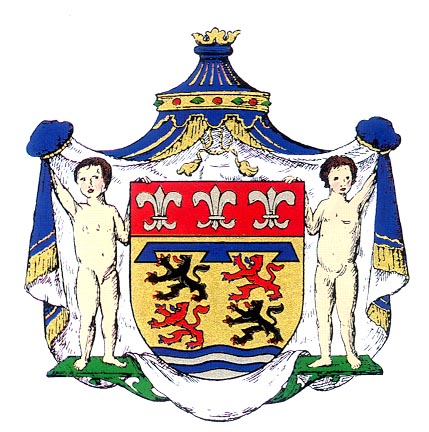 City Arms |

Grotere kaart weergeven