The Jewish communitie of Borculo
Sources:S. Laansma, De Joodse gemeente te Borculo
(Borculo, Eibergen, Groenlo, Lochem, Neede, Ruurlo).
H. Kooger, Het oude Volk-Kroniek van Joods leven in de Achterhoek, Liemers en het grensgebied.
Borculo
It was well known in Jewish circles that during the 19thand the 20th century Borculo was one of the most religious and pleasant communities in the "mediene," with great Jewish knowledge and experienced Jewish teachers.
There are not many sources with regard to the Jewish population of Borculo during the 17th century, but it is certain that Jews lived there as from the year 1642. After 1642 a bit more is known, because the Jews had to pay a residence tax, the so called "tribute."
In 1642 the "Jew from Nede" paid the steward of the Borculo court the residence tax of six guilders. After one year the same amount was paid by another Jew, who was mentioned by name: The butcher Joost Israels, who supplied fresh meat to the court of the Count of Borculo.
Afterwards Jews in Borculo or surroundings are being mentioned with almost small interruptions. Samuel from Eibergen, Joseph Sanders and Elias Moses, are mentioned, in connection with residence permits, the sale of cloth and the provision of "fatty geese."
The archives provide no further names till 1660. Between 1660 and 1665 tribute was paid by Elyas de Jode, Joseph Sanders and Moises Joosten, who also, yearly, supplied the Court with fatty geese. During that period we also find the name of a woman, Hester the Jewess, who passed away in 1665.
With the start of the Second English war in 1665, "Bommen Berend," the Bishop of Munster, invaded and conquered the Achterhoek, but Johan Maurits of Nassau expelled the invaders with French help.
Some Jews fled the region and some arrived, like Meyer and Hertz Meyer. The Bishop of Munster appeared again, and some Jews fled while others arrived.
In 1674 the army from Munster disappeared, and Borculo became part of the county of Zutphen.
In 1677 appeared "Moses the Jode." He was the owner of a small shop and, consequently, he paid two guilders yearly as excise-duty. He was also known as Mosis Simons and Moses Heyman. He passed away in 1707.
Another Jewish inhabitant was Salomon Heyman, who managed a pawnshop in 1684. During the following years, Jews – probably from the same family – paid their tribute to the Count.
In 1726 another Jew appeared in Borculo. He obviously owned a house, because he paid tribute for his "homestead."
In 1769 a Jewish physician moved to Borculo. In 1774 he paid a tribute of six guilders.
All Jews wishing to settle in Borculo had to provide a so called "letter of recommendation." Such a letter, usually issued by the place of origin, was proof of good behavior and confirmed the honest lifestyle of the holder.
At the start of the 19th century several Jewish families lived in Borculo, amongst them the known physician Eleazar Pool. He was even summoned to treat one of the daughters of the House of Orange in The Hague. He appeared in his working clothes, which he also wore in Borculo and one of the physicians there asked in Latin: "What is this farmer doing here?" It seems that Eleazar Pool replied: "Even a farmer is able to cure a patient, provided he has some medical knowledge!"
Dr. Pool's family came from Chmielnicki in Poland, which they had to leave because of pogroms.
During that period all families had to choose family names. We find Jewish family names like Pool, Hartog, Elzas, Elias, Philip, Rosendaal, Lobstein and Leverpoll.
In 1810 there were about 40 Jews in Borculo; about 1850 there were 100.
The Synagogue
Till the year 1840 the kehilla came together for prayers in a so called home synagogue. In 1840 the first stone was laid for a real synagogue, in the Weverstraat. For the laying ceremony of the first stone there were so many candidates that the community decided to sell the honor by bidding, starting with 40 guilders. In order to cover at least a part of the construction costs, a lottery was organized.
Regrettably nothing is known about the inauguration itself, which took place in the second half of August 1877.
The new synagogue stood in the same spot as the old one. It had a broad street façade, with neo-Baroque pilasters, Ionic capitals and profile frames.
Till the year 1910 not much is known about Jewish Borculo. After 1910
Mr. L. Borstrok became chazzan and shochet and also fulfilled the position of the religion teacher.
Till 1930 the widow van de Kamp was responsible for the mikve. In 1913 the community assisted in building a house for her.
During the same year electric light was installed in the synagogue, in the mikve and in the school. In 1914 an electrical pump was installed in the mikve.
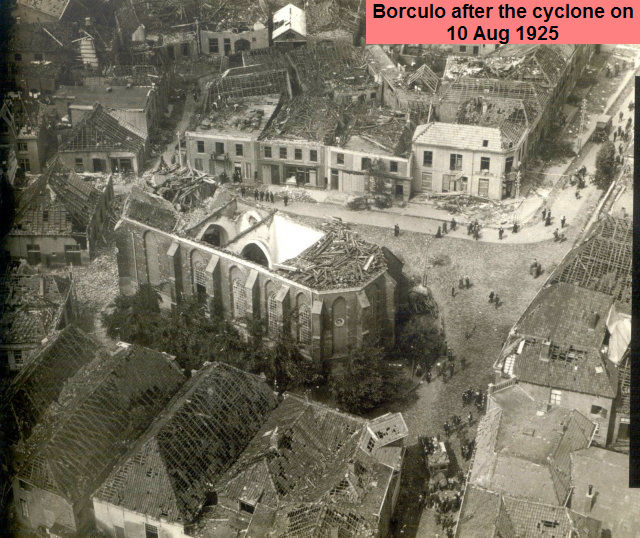
In 1925 there was a big storm disaster, causing terrible damage to the Catholic and Protestant churches. The damage to the shul was relatively small and the repair costs amounted to 200 gulden only.
During the Second World War the synagogue was seriously damaged as Dutch sympathizers with the Nazis burnt the building. The Torah rolls, hidden earlier, were all saved.
After the war, the synagogue had become too large for the diminished community and was consequently sold.
After the liberation in May 1945, services were held at the home of one of the community members till March 1946. Afterwards services were held at the restored Jewish school building, dating from 1926, which now served as a synagogue. At this opportunity a painting depicting the old synagogue was presented. The synagogue ornaments which during the war had been hidden behind the fire extinguisher of the fire-brigade were taken into use again. In the new synagogue were several murals, and some memorial stones from the old one.
Jewish schooling
On 1 December 1834 the Jewish community of Borculo asked permission to build a Jewish school. No proof has been found, but it is almost sure that their request was granted. Presumably this school was built vey near the synagogue in de Weverstraat. The teacher also lived in the same building. When in 1877 this house had to be demolished to make place for the new synagogue, the teacher lodged in homes of members of the Jewish community.
The children had to learn brachot, chumash and prayers and they were also required to study more difficult material, like Rashi (Bible and Talmud commentary) and Shulchan Aruch (codex of laws). They also were taught "laajnen" (singing and reciting) of the Torah.
After the cyclone in 1925, which ruined the school building completely, a new school was built at the Korte Wal, which was inaugurated in December 1926.
All this came to a cruel end. After 1945 a few children remained, who were being taught in the renovated school building, which also served as a synagogue from March 1946.In 1961 some children still received Jewish schooling, but the community had become so small that even this had to be stopped.
Cemetery
The old cemetery at the Lange Wal was not used anymore after 1820. Till today an oblong stone with Hebrew letters is being kept there. In 1936 the mayor of Borculo asked J. Vredenburg,the chief rabbi of the province, permission to move the stone to the Jewish cemetery, in order to build a house on that spot. The chief rabbi did not give his consent.
The remaining stones were apparently removed, but there is no available information on this point.
The reason for closing the old cemetery, which was certainly in use since 1800, was that the bodies of the deceased came to be laid in groundwater in the freshly dug graves.
A new cemetery was bought at the Deugenweerd in 1832.There were three burial registers. The first one has disappeared, and in the remaining ones more than 180 deceased were registered.
In the small metaher room there is a beautiful stone in Hebrew, reminding the living of their mortality and of the resurrection of the dead.
The terrible storm in 1925 caused almost no damage to the cemetery. The cemetery has 129 tombstones, and is maintained by the Borculo community.
Means of living
The Jews of Borculo had several occupations. From the 17th century and onwards there were Jewish butchers, slaughterers, merchants and shopkeepers. Already in the 18th century there was somebody who worked for the town, "setting glass windows."They also traded in used iron. Later on, in the 18th century, there was also a family of doctors in medicine.
In 1830 a small factory was opened for the preparation of parchment and somewhat later a second one. Both factories developed and became well known. Parchment was used for drums, for lamp shades and by bookbinders and orthopedics. It was also used for drawing up important deeds.
Regulations
On 28 February 1862 the regulations for the Nederlands Israelitische Gemeente at Borculo were issued, including voting regulations. The regulations existed of 129 articles which included chapters regarding the management of the Jewish community, the chairman, the treasurer, the budget, the care for the poor and more.
In all Jewish communities, the membership of the father of the family included the membership of his wife and children.
When members were punished by law with "dishonorable punishment," their names could be deleted from the registers of the community.
The official church dignitaries were the Jewish teacher, the chazzan (cantor), the beadle and the butcher.
The personal tax payment for the kehilla was divided into ten grades. The lowest grade was a payment of three guilders a year, and the highest 50 guilders. The seats in the synagogue were hired once a year. Community members did not have to pay burial expenses. Members disturbing the prayers were fined. Each male member was obliged to join the men's society and all female members the women society.
Communal societies
The "kille koudesh" (the holy community) of Borculo was known for its many religious and social societies. The oldest one was the "Talmud Torah" from 1864, which held its last meeting in 1940. The Talmud was of high importance in "kille," and was daily studied. These studies were supervised by lay teachers, holding the title of "Mereine" (Morenu, our teacher). A memorial stone commemorating the "Talmud Torah,"is found in the synagogue.
The "Ateres Bachurim Gemilus Hasodim" was another society where all male community members above 13 years could enroll, paying a weekly contribution of 3 cents. Members from 18 years could vote and from 20 years they took part in assisting the ill and the cleansing of the dead prior to burial. The society employed several employees, like a teacher and a beadle.
One of the duties of the teacher was to pray with very ill people, or to speak at a burial. The beadle had to be at least 20 years old. He had to be present at least five minutes before prayers and was responsible for the belongings of the society. During the shiwe, the week of mourning after the burial, he was obliged to pay a daily visit to the grieving family members of the deceased.
In 1910 a devotional society of young men "Agudas Achim," was founded. A drama club, "Unity is our goal," was founded in 1906. There were Jewish dancing lessons and yearly meetings, which were called "shadgen" days – a kind of marriage market. Most Jews went to the synagogue every day and of course on Shabbat and holidays.
The neighboring farmers received matzoth for Pesach, a gesture which was highly appreciated.
About the women society no details have been found.
Jews in Borculo
During the Second World War more than half of the Jews from Borculo were in hiding, thereby saving their lives. The others were murdered by the Germans.
Year Jews
in Borculo
1809 77
1840 110
1869 163
1930 139
1951 48
1971 54
Extracted from sources:-Yael Benlev-de Jong
Translated from Dutch:-Mechel Jamenfeld
Editing:-Ben Noach
Final editing:-Hanneke Noach
Search the Web Site
Search All genealogy family trees / Northern
province database / Ashkenazi Amsterdam database / The Nijmegen
family trees / The regional family trees /The whole
website
REMARK:- Please note that the search results give all instances where the requested search string figures in the databases.So not only the name of the location, but also persons, that bear the name of the town or the village, are included in the results returned.
 |
 |
