The Jewish community of Harderwijk
-:Names mentioned in the article in order of appearance
Till the names adoption (1811):-
Gabriel de Salazar, Johanna Mulert Johansdr., family
Italiaander,Jacob Eleaser, Heiman Mozes Heiman,
Salomon Heiman, Cosman Jacob Marcus,
Emanuel Benjamin, Jacob Meyer Cohen,
Godschalk Mozes, Asser Ephraims, Abraham Gabriels,
Mozes Israel da Costa, Abraham de Vries, Josephus
Veersheim, Benjamin
de Serra,
The early period
Already during the Middle Ages, Jewish communities, or
groups of Jews,
settled in the former duchy of Gelre, especially
along the Rhine and the IJssel.
In 1349 a terrible plague broke out and the Jews were
accused of having poisoned the wells. A horrible
massacre took place by large groups of "Flagellants," a
kind of religious fanatics. The same happened in Gelre.
The Jewish communities of Arnhem, Nijmegen, 's
Heerenberg, Deventer, Zwolle and Kampen, were destroyed.
Although Harderwijk was at the time a Hanzeatic city and
an important commercial center, it harbored no Jewish
inhabitants, possibly because most of the commercial
connections of Harderwijk were aimed at the Northern
countries. The Jews however
migrated from the south and had their connections
usually with the Rhine region.
By edicts of
Karel V and of Alva in the year 1570, the few Jews from
the North of Holland were expelled.
The first Jews to settle there again
were the Marranos, Jews from the
Iberian Peninsula, who had been
living there as crypto-Catholics
since the inquisition in 1492. They
chiefly settled in the big cities,
mainly in Amsterdam, but also in
smaller places. Some places welcomed
the settlement of these people, due
to their commercial connections.
Harderwijk however seemed not to be
among them. Nevertheless somebody by
the name of Gabriel de Salazar was
mentioned, married to Johanna Mulert
Johansdr., who passed away in 1590.
It is not entirely clear whether de
Salazar was a Jew, but there is no
doubt that his family name was of
Marranos origin.
In about 1600 the family Italiaander
settled in
the adjacent town of Nijkerk.
They were
tobacco growers and
merchants. They kept a
home-synagogue and over the years a
Portuguese community was formed
there.
The first report on Jews, in the old
archives of Harderwijk, dates from
1657. One Jew, who had settled in
the small town, had to leave since
"Jews are not allowed to live here."
It is not clear whether this decree
was based on an earlier resolution
of the town fathers. It is possible
that Zutphen, with which Harderwijk
had close connections, served here
as an example. Jews were not allowed
to live in Zutphen till 1796, when
legal emancipation put an end to
such practice. On 11 March 1667 the
Town Council allowed the Jewish
butcher Jacob Eleaser to settle in
town.
The synagogue
Unlike towns like Arnhem, Wageningen,
Zwolle, Amersfoort en Nijkerk, the
Jewish community in Harderwijk was
established only in 1759, and always
remained small and insignificant.
This was strange for a town which,
at the time, had favorable
connections by land and sea and
moreover possessed a university.
Possibly Heiman Mozes, holder of the
loanbank, kept a home-synagogue,
since he lived
in Harderwijk for about 27
years.
In 1759 the Town Council allowed Heiman and Marcus to
hold Jewish religious services in a backroom, rented
from Marten Vermeer. Obviously they had a "minyan" only
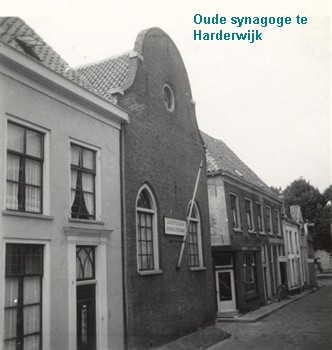
then. In 1773 a synagogue was founded, or maybe was
already in existence. When this synagogue had
deteriorated, a new one was built in 1817 in the
Jodenkerksteeg. Maintenance costs were covered by fines,
membership fees from new members and
from the so called "schnoderen," a voluntary
contribution by people called to the Torah. In 1839 this
synagogue was restored and remained in use till the
second World War. A stone commemorizes the restoration.
The synagogue itself remained intact during the war, but
the ornaments and the Holy Ark disappeared. It is
possible that the Torah scrolls were transferred to the
synagogue of Winterswijk. After the war, in 1947, the
synagogue was sold to the municipality of Harderwijk.
The Mikwe
In 1762 mention of a "mikwe" is made
in one of the documents.
The cemetery
A document from 30 September 1716
confirms that on that date "the
excavated wall behind the Great Gate
was ceded to the holder of the bank,
Heiman Mozes Heiman, to be used as a
cemetery for him and his servants."
It is unknown whether this spot was
ever used for this purpose. In 1764
another cemetery was inaugurated,
obviously also behind the Great
Gate, and from 1852 a cemetery in
Tonsel was used. After the war the
community of Harderwijk used the
present cemetery in the Lindenlaan,
which
has been well kept till
today.
The Jewish school
Till 1857 the Jewish children
studied at a Jewish school.
Afterwards they studied at
the public regular school and
received Jewish schooling in a new
classroom. The same building also
housed the mikve and a meeting room.
Sustenance
Like everywhere, the Jews in Harderwijk could not become
guild members and therefore they were only able to make
a living by commerce and trade. In Harderwijk this
included among others, the tobacco trade. But they could
also become butchers and it seems that in this capacity
they were quite welcome. There were also lotteries and
the loan bank was in Jewish hands. There were poor
families and also well-to-do ones.
The Loan Bank
On 19 September 1715 Heiman Mozes Heiman received a
charter to lease the loan bank for a period of 12 years,
under the same conditions granted to the holder of such
a bank in Zutphen in the year 1660, provided that he
would make a yearly payment of 10 guilders to the town
and 25 guilders each to the orphanage and the hospital.
The first Jews allowed to settle in
most towns, were often the owners of
the loan bank. That the arrival of
Heiman Mozes Heiman was
accepted by the town, is found in an
official record from 30 September
1716, stating that for the loan
bank, founded in 1590, "we have been
looking for a Jewish bank holder for
a very long time."
On 5 March 1742 the Town Council
allowed the children of Heiman Mozes
Heiman,
to keep temporary possession of the
bank.
However in the year 1754 Salomon Heiman yielded his
banking charter. The bank was leased to Jacob Marcus &
Sons. In 1771 it was recorded: "Cosman Jacob Marcus, as
heir to his father Jacobus Marcus, is obliged to
continue the leasing of the loan bank till 1 May 1772."
In August 1774 Emanuel Benjamin and Jacob Meyer Cohen
took over
the leasing for 1/16 of its profit and even in 1846 a
Jewish inhabitant of the town leased the bank for 332
guilders a year.
Lottery
For the organization of the
"chartered town lottery" assistance
from Jewish side was solicited, as
appears from the names of Godschalk
Mozes and Asser Ephraims.
Abraham Gabriels a former money
changer in Amsterdam and later a
citizen of Harderwijk, was a
remarkable and colorful character.
For many years Harderwijk lacked a good harbor, where
ships could easily anchor. In 1762 Abraham Gabriels,
together with some non-Jewish business partners, offered
a solution which apparently would solve the problem.
A so called tontine loan would be
arranged, which would cover the
building of a harbor, costing about
200,000 guilders. During the lottery
sale, Abraham Gabriels, discovered
some coins which were too
light. After further inspection it
turned out that fraud had been
committed.
In 1763 Abraham Gabriels discovered
the culprit and travelled to the
Hague, to meet the general essayist
of the United Netherlands. After
investigation it turned out that the
guilty person was the corrupt mint
master C.C. Novisadi, who was very
influential. Gabriels was taken
hostage. The citizens of Harderwijk
objected and succeeded in freeing
him. The corrupt mint master met a
bad end, but Gabriels did not
receive the approval and thanks due
to him. He only received a small
compensation for his expenses.
Furthermore he regrettably had to
declare that he and his partners
were unable to recruit the necessary
funds for building the harbor.
Citizen Gabriels became "the Jew
Gabriels" again.
The university of Harderwijk
Harderwijk had a university.
Notwithstanding the decree from
1657, forbidding Jews to live in
town, Mozes Israel da Costa promoted
a year later at the university and
received a law degree. The fact that
Jewish students were living there,
may have been the reason that the
kosher butcher, Jacob Eleaser,
received permission in 1667 to
settle in Harderwijk. In 1690 "Jews
are permitted to live here and to
establish their business". In 1706
Jews were still not eligible to
receive civil rights, but in 1716
they could become "poorters," which
still did not entitle them to full
civil rights.
In 1711 Abraham de Vries promoted in
Harderwijk. He
became a doctor to the poor
at the Ashkenazi Jewish community in
Amsterdam. In 1760 Josephus
Veersheim promoted there, who
fulfilled the same function at a
later date. More Jewish students
promoted in Harderwijk especially in
medicine.
It is remarkable that in 1683 a
Jewish student from Antwerp,
Benjamin de Serra, was promoted tot
Medicinae Doctor. He was however
required to take not only the
Hippocratic oath, but also a second
one, promising to assist not only
his own fellow believers but also
Christians.
In 1744 one student objected to take
the oath bareheaded and Professor J.
de Gorter allowed the taking of the
oath with a covered head. Obviously
there was a sympathetic attitude
towards the
Jews. Professor Johan Meier
also lectured at this university. In
1715 he successfully defended some
Jews from Nijmegen, accused of
ritual slaughter. As a rule the
relations between Jews and non-Jews
in Harderwijk were good.
The founding of a community
It goes without saying, that the Jewish community of
Harderwijk was not founded by the privileged group of
university students, who stayed in town only
temporarily, and certainly not by individuals, like the
butcher Jacob Eleasar, who usually came and disappeared.
The founding of the community should
rather be credited to Heiman Mozes Heiman, who, as mentioned before,
received a license in 1715 to maintain a loanbank and
who after a year was offered a cemetery behind the Large
Gate. It seems that till his death in 1742 he remained a
banker. There is however no proof at all that he was
indeed buried in the piece of ground allotted to him.
Quite often Jews were buried in
another town, lacking a cemetery of
their own.
The facts show that the Jewish
community as a whole was
acknowledged as such.
In 1659 it was decided that only
protestant-reformed persons could
become burghers of the town, but in
time this position was moderated,
also with regard to Jews.
As mentioned above, in 1706 the Jews
of Harderwijk received "poortrecht",
but no civil rights. They were not
entitled to execute any profession
connected to a guild, but they did
have to pay for these services. The
document from 1762, mentioning the
mikwe, also noted the obtaining of
civil rights.
During that period, subjects like
caring for the poor and matters
about a synagogue
show up in the documentation. Jews who wanted to
get married were ordered to do so according to the
existing laws, and not only according to Jewish
synagogue law. The Parnassiem were ordered not to
receive Jewish guests from out of town, without ensuring
prior agreement from the Mayor. The following document
stressed the insecure position of the Jews: "And finally
the Jews in general and everybody of them, are being
ordered to keep rest and peace amongst each other. At
the first
proven complaint they will be punished either by the
closure of their church, or by being forbidden to live
here any longer. In that way their community and
households will be punished and ligitated against as
facts show !"
It was clear that the Jews were not
allowed to quarrel amongst each
other.
In 1862 a new set of regulations was approved. At that
time the members of the Jewish community were divided
into two groups: the matriculated and the non-
matriculated. The members of the first group were able
to purchase their membership,
while the second group had not been able to pay the
required amount of purchase, which was 20 till 30
guilders.
The first group enjoyed several privileges: They could
become a member of the synagogue council, or receive
assistance in case of poverty. Only those of perfect
moral behavior were eligible and those who were married,
had to be married in accordance with general
and Mosaic law.
Since voting rights were connected to prosperity, it was
only a small group of people who made all decisions. The
church council had absolute power, from birth to grave,
everything was fixed by regulation.
In 1809 the Jewish community counted 38 members. In 1817
there were only 9, mostly poor. During the 19th century the Jewish
community kept growing, but as a whole, remained rather
small. In 1821 the community belonged to the network
synagogue of Elburg. In 1840 there were 56 members, in
1869 there were 192. After 1885 membership decreased,
like in most small Jewish communities in Holland, since
many left for the big cities. In 1899 there were only 81
members left in Harderwijk.
In 1930 there were 57 members. In
1913 the communities of Harderwijk,
Ermelo and Putten, had a joint
membership of 57 members: 53 were
Dutch-Ashkenazi and
4 Dutch- Portuguese. In 1930 there
were 57 members and in 1938, 56.
After the war the Jewish kehilla of
Harderwijk was left with only 10
people.
The French period
In 1796 the French period propagated
equal rights for all civilians and
segregation of church and state. The
local authorities were not allowed
anymore to interfere in church
matters of any congregation. It
became obligatory to choose a family
name, which also applied to the 38
Jews in Harderwijk.
Summary
The Jewish community owned a
synagogue, founded in 1817, located
at the so called "Jodenkerksteeg."
They had a cemetery of their own, a
ritual bath, a room for biblical
study and a school for religious
instruction consisting of two
classes. The community employed - an
unpaid - ritual butcher and
and a gazzan, who was also a
teacher, against payment.This paid
employment ceased in 1911.
Afterwards the community could not
afford this anymore, and the
position was taken up by young men
who had just got their degree.
They had two
societies: Talmud Torah and Hevras Nosjim shel Emmes for
women. The first one dealt with the study and
commentaries of the Bible, while both societies
assisted sick persons and the dying and took care
of the deceased.
In 1907 there was some commotion
when the mayor, Mr. Kempers, moved
the elections for the municipal
council to a Saturday. The council
drew his attention to this fact, but
the mayor replied that “the
Jews are only guests here”. This
happened more than a century after
emancipation! The intervention of
the Dutch Prime Minister, Dr. A.
Kuyper was required.
About 1920 Jewish refugees from
Eastern Europe came to Harderwijk.
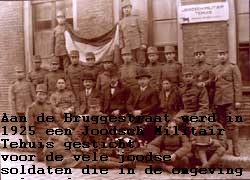
In 1925 a Jewish Military Home was
established there, because many
Jewish soldiers from Amsterdam were
quartered in Harderwijk; the Jewish
community was happy with this
influx.
In 1947 the community of Harderwijk
was abolished. What was left, was
annexed to the community of
Amersfoort and the synagogue was
sold to the Harderwijk municipality.
Source:-Map “Harderwijk” with sundry
articles and other material in the
library of the
Center for Research on Dutch
Jewry (Jerusalem).
Translation into English:-Mechel
Jamenfeld
Editing:- Ben Noach
Final review :- Hanneke
Noach
Search the Web Site
Search All genealogy family trees / Northern
province database / Ashkenazi Amsterdam database / The Nijmegen
family trees / The regional family trees /The whole
website
Search All genealogy family trees / Northern province database /
Ashkenazi Amsterdam database / The Nijmegen family trees / The
regional family trees /The whole website
REMARK:- Please note that the search results give all instances where the requested search string figures in the databases.So not only the name of the location, but also persons, that bear the name of the town or the village, are included in the results returned.
The old Synagogue of Harderwijk
Soldiers in Harderwijk. 1925
The Hartog and Beem families
Grotere kaart weergeven
