The Jewish community of Weesp
Background history
It is a proven fact that Jews have lived in Weesp since
1774 at least. They were mainly Ashkenazi Jews of
Central and East European origin. They probably already
lived there since 1725-1750 because it was in 1774 they
took a synagogue into use. The first official count of
the number of Jews took place in 1809, when Louis
Napoleon introduced the registration of citizens. At the
same time Jews also took on family names. In that year
there were 104 Ashkenazi Jews in Weesp and its immediate
surroundings. After that the number grew, but later it
again diminished. Herewith some numbers:
1800
141
1840
153 (out of a total number of inhabitants of
6,500 in Weesp)
1860
153
1899
101
1930
49
The synagogue council in Weesp consisted of 5 members,
two of whom were responsible for the care of the poor
and one acted as treasurer for donations for the Holy
Land.
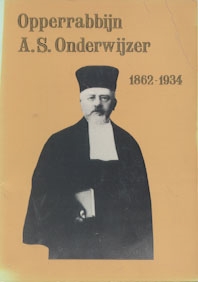
The
most famous member of the community was A.S. Onderwijzer
(1862-1934), who would later become Chief Rabbi of
Amsterdam. See under “Famous Persons”:
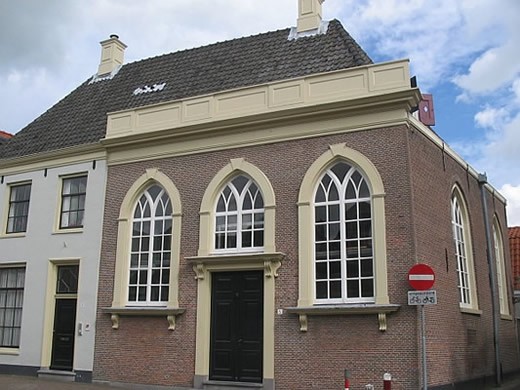
Synagogue
The
synagogue in the Korte Midden Street, which was taken
into use in 1774 was probably a house synagogue. This
shows that at that time there already was minyan in
Weesp. In 1840 the building was almost collapsing and in
any case it had become too small. Therefore, plans were
made to build a new synagogue for which, obviously,
money had to be collected. Thus, on Friday, October 30th,
1840 the new synagogue in Nieuw Street was inaugurated.
Even Chief Rabbi Berenstein of Amsterdam was present and
held the service. Other representatives from Amsterdam
were Gabriel J. Polak and Cantor S. Frijda. The program
also included prayers for the city of Weesp, by which
gratitude was expressed to the municipality, which
together with the nation and the province had made the
building of the synagogue possible. These prayers were
contained in a poem,
an ‘Evocation’ (“Uitboezeming”), a felicitation
in 5 couplets, written by J.W. Berlijn of Amsterdam.
The
greatest impact of the inauguration of this synagogue
was the fact that the Weesp Synagogue
served as a provincial synagogue. The Jewish
community of Weesp consisted namely also of the small
towns of Muiden, Nederhorst den Berg and Wespercarspel.
When the new synagogue was four years old, it became the
target of disturbances: On Wednesday, April 10th,
1844 the evening prayers of the Israelites in Weesp were
disturbed by the wanton, furious shouting of a group of
boys. Thereupon an assemblage of people took place, part
of which went through the town and broke into the
windows of many Israelites as well as of the synagogue,
before the police could put a stop to this.
Also we
found on record:-
The cause of
these disturbances could be found in the false rumors of
a single woman, who regarded the innocent game of a few
Israelites with some Jewish children in the public
street as a mockery of the Christian religion. She had
not neglected to spread these rumors together with all
kinds of additions and conclusions, especially amongst
the lower classes. After this case had been lodged in
front the Court of Law in Amsterdam some of the guilty
persons received corrective punishment.
Slowly
but surely Jewish and non-Jewish relations improved in
Weesp - this
seems obvious as there was no more mention of any
incidents.
In 1878
a new home for the cantor was built. For this purpose
the synagogue council bought a parcel of land in the
Sleutelsteeg, a narrow alley which ended on one side at
the Oude Gracht and on the other side at Nieuw Street,
where already since 1774 the synagogue was situated. It
was a modest building in a rather somber alley. On the
right side of the main entrance the synagogue council
had a front stone installed on which mentioned the year
1878 and on top of this 5638 – according to the Jewish
year. The Jewish community in Weesp never had its own
rabbi and the cantor officiated as head of the Jewish
community. In spite of the modest means, this was for
him a full-time job. He led the religious services, was
active in Jewish charitable societies, he looked after
ritual slaughter, kept up relations with the religious
leaders in Amsterdam and visited Jewish citizens.
In 1873
rules were made up with stipulations for attending
synagogue services. It was forbidden to visit the
synagogue improperly dressed, each male visitor above
the age of 13 had to have head-gear, during the service
talking was forbidden, parents were responsible for the
behavior of their children and ‘with each act against
one or more of the articles in the Regulations of Order,
the synagogue council (after a previous warning) would
impose a fine of 1 to 5 guilders, without the church
council losing the right to have each disturber of the
peace removed from the synagogue building by the
police’.
During
the Second World War only the ‘Aron Hakodesh’ was saved,
all other objects and ornaments have disappeared. After
the restauration of the Synagogue in 1984 a plaque was
attached in memory of the Jewish community in Weesp. The
building was at first used as a garage and later it was
the office of the Labour Bureau. In 1997 the building
was again taken into use as a synagogue. The dwelling
besides it ,
houses the consulting body for the dialogue between Jews
and Christians.
The
Jewish School
The
Jewish School was situated at Slijt street – a small
school which functioned very well. In 1888 23 children
attended this school, 12 boys and 11 girls. On Sundays
they had lessons from 9 to 12 and from 3 to 5 o’clock.
Mondays and Tuesdays they had lessons from 4.30 to 7.30,
Wednesdays from 3 to 7 o’clock, etc. The religious
school consisted of 3 classes.
The
Jewish cemeteries
One of
the early restrictive measures for Jews in the
Netherlands was that they were not allowed to bury their
dead within town borders. This measure from times past
is still evident as Jewish cemeteries are situated far
beyond the old cities borders. For Amsterdam one can
find the cemeteries in Diemen and Muiderberg for
Ashkenasi Jews and in Ouderkerk for the Sefardic Jewish.
Jews from Weesp were often buried in the cemetery of
Muiderberg.
Jewish
Societies
Like in
other Jewish communities there were several Jewish
societies in Weesp, like Gemiloeth Chasadiem which
looked after the cleansing and caring of deceased Jews
in Weesp. The other society, Tiferes Kehiloseinoe (“The
Ornament of our Society”), dealt with more earthly
matters, like looking after the inventory of the
synagogue and everything that was necessary for the
religious services. There was also the ladies’ society,
Ma’asim Towim (“Good Deeds”) which dealt with financial
support of the poor, maternity care and newly accepted
members (persons accepted as members of the synagogue
community). There were, however, also Jews who were
members of non-Jewish societies in Weesp, like the
Oranje Society.
Several
members of the Jewish community of Weesp were members of
the town council.
Professions
There were not many Jews in Weesp but it is nevertheless
worthwhile to shed some light on
their occupations. There was a Jewish butcher and
his wife ran a shop of fashion goods which went very
well. There was also a cattle dealer. There were three
junk-dealers who traded in irregular goods like
inventories, metals, rags and hides. Before and shortly
after World War II the word ‘rag-jew’ was a concept.
There also was a Jewish woman with a fruit stall.
A considerable number of Jews in Weesp had textile shops.
These shops sold all kinds of things: materials,
mattresses, curtain materials, clothes, floor covers and
underwear. One son of one of the families was a wireless
operator with the merchant marines – the pride of the
whole family. There was a tailor and his wife has a
milliner’s shop. There was a sweet-shop which also sold
ice-cream and there also was a Jewish baker.
The end
During
the thirties several Jewish refugee families from
Germany came to live in Weesp.
Regretfully the end of the Jewish community in Weesp is
well-known. Of the sixty-five Jewish men, women and
children only seven returned.
In 1947
the Jewish community of Weesp was merged into one
community with Bussum.
Source:-
book:-Geschiedenis van
de Joodse gemeenschap te Weesp.
C 1983 Boekhandel De Ark / Uitgeverij Heureka, Weesp
Druk: Krips Repro, Meppel
ISBN 90 6262 092 2
Extracted in Dutch from the source-Yael Benlev-de Jong
Translation into English:-Nina Mayer
Editing:- Ben Noach
Final
review:- Hanneke Noach
Search the Web Site
Search All genealogy family trees / Northern
province database / Ashkenazi Amsterdam database / The Nijmegen
family trees / The regional family trees /The whole
website
Search All genealogy family trees / Northern province database /
Ashkenazi Amsterdam database / The Nijmegen family trees / The
regional family trees /The whole website
REMARK:- Please note that the search results give all instances where the requested search string figures in the databases.So not only the name of the location, but also persons, that bear the name of the town or the village, are included in the results returned.
The Synagogue
Chief Rabbi A.S. Onderwijzer
Grotere kaart weergeven